Perspective
The institution is the unit of change
A firm asking to be trusted with consequential questions should show its reasoning in public. Four assertions the work rests on, what each one means in practice, and where the argument is set out at length.
The position
- 01
The institution is the unit of change.
AI applied to the organisation as it stands produces activity, not movement. What changes an institution is a change to how it decides, who holds authority and how work is actually done.
What followsDiagnose the machinery of decision before funding another initiative.
Executive Diagnosis - 02
A collection of use cases is not a transformation.
Twenty pilots in seven regions is a portfolio nobody decided. Without a rubric that can stop one, every initiative survives on advocacy and the institution learns nothing from any of them.
What followsInstall the rubric that lets a board fund one thing and stop another, before the next pilot.
Institutional Design - 03
Governance has to continue through execution.
Governance written at the start and abandoned at the build is theatre. The thread only means anything if the authority under which something was executed is recoverable afterwards, from the same record.
What followsKeep one accountable design across the decision, the build and the evidence, rather than three owners and a gap.
Governed Intervention - 04
Some judgements should not be extended by machine.
Knowing where AI must not decide is as commercial a question as knowing where it should. A board that cannot state the line in one sentence has not made the decision, it has deferred it.
What followsState the boundary explicitly, and put it where the people doing the work can see it.
Institutional Design
We publish what we practise
The books are where the method is set out in full. The four below are the catalogue this firm draws on.
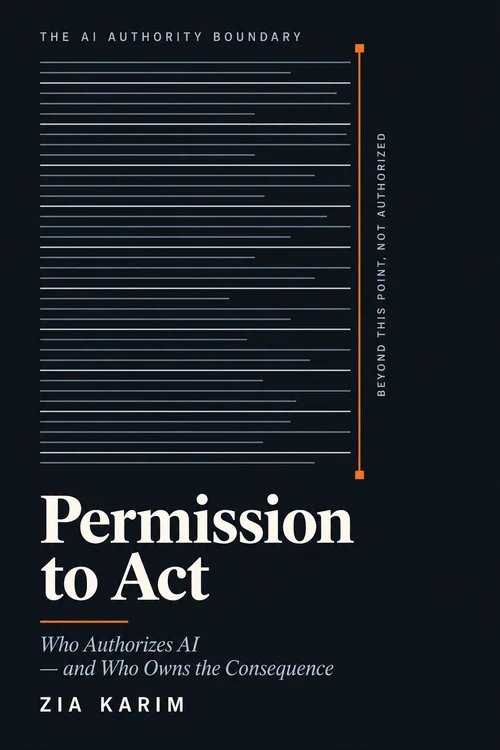
Permission to Act
Permission to use a tool is not permission to act. The operational boundary that determines what AI may do, when it must stop, and who owns the consequences — with the evidence to defend each decision.
Explore the book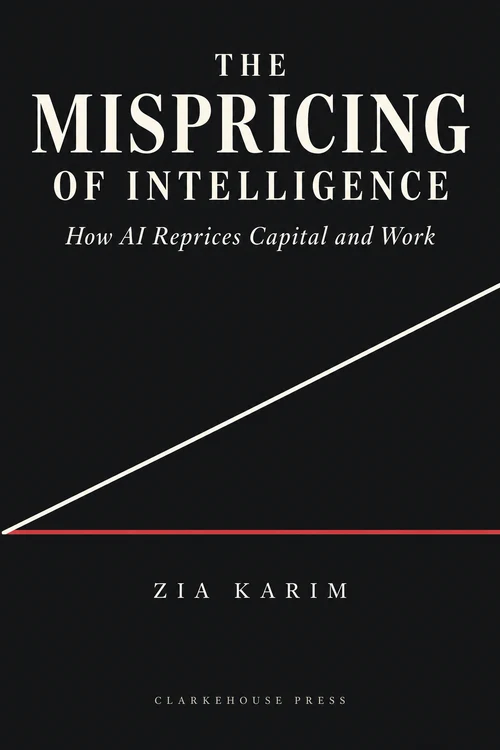
The Mispricing of Intelligence
The seller’s revenue is not the buyer’s return. Why cheaper intelligence does not guarantee enterprise value, and how accountability, organisational design and capital allocation determine who earns a return on it.
Explore the bookThe AI Periodic Table
Forty-eight elements, thirty-five compounds: the parts every AI programme is built from, and what they make when they combine. A diagnostic for the people who answer for what the system did.
Explore the bookIntelligence Leverage Stack
Treating AI as a tool produces incremental gains. Architecting it as an operating model restructures cost and speed. AI deployment as a structural event, not a productivity initiative.
Explore the bookThe full catalogue, including the Structural Saturation trilogy on why effort stops converting into progress and the work on the micro-institution, is at clarkehousepress.com.
We take on a small number of engagements at a time.
If your institution is somewhere between AI ambition and AI evidence, that is the conversation this firm is built for. Write to either of us and we will tell you plainly whether it is work we should be doing.
Discuss a consequential decision